
On this page
I usually do five sets of about 30 seconds. For me, dead hangs feel great through my back, lats and shoulders, and over time I have noticed better comfort and flexibility in those areas. That is my personal training experience—not medical advice and not proof that hanging treats back or shoulder problems.
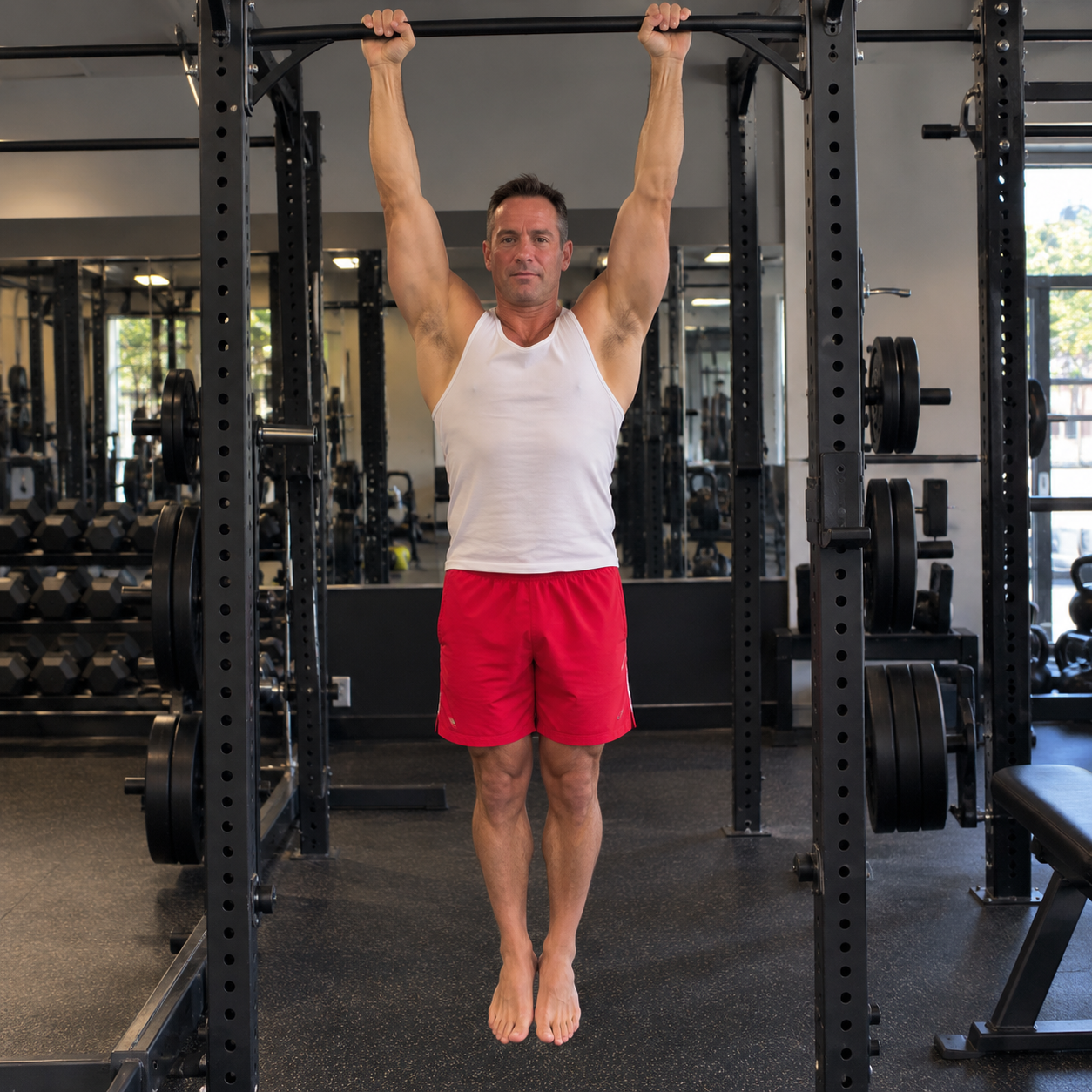
What is a dead hang?
A dead hang is exactly what it sounds like: you hold an overhead bar and let your body hang beneath your hands. Your feet are off the floor, your elbows stay straight, and your grip supports your body weight. It looks almost too simple to deserve an article, which is probably why the exercise has become such a good internet topic.
The simplicity is also what makes it useful. A dead hang challenges support grip, exposes you to an overhead shoulder position and asks you to control your body while gravity does the loading. You do not need a complicated machine or a 12-step routine. You need a secure bar, enough shoulder tolerance for the position and the judgment to stop before your grip fails unexpectedly.
There are variations. In a relaxed or passive hang, you allow more elevation through the shoulder blades. In an active hang, you create a small amount of shoulder-blade depression without bending the elbows. Neither needs to become an extreme stretch. Think controlled hanging, not trying to pull your shoulders apart.
Dead hang benefits: what is realistic?
The clearest training benefit is grip endurance. Your finger and forearm muscles have to keep you attached to the bar. Research on climbers is not the same as research on middle-aged recreational exercisers, but studies of structured dead-hang training do show that hanging protocols can improve grip endurance in trained climbers. That is biologically unsurprising: repeatedly asking the grip to hold a load trains the grip.
Hanging also puts the arms overhead and can feel like a strong stretch through the lats, chest and surrounding tissues. That is the part I personally enjoy most. After a set, I often feel looser through my upper body. But feeling a stretch is not the same as proving that dead hangs permanently increase shoulder mobility or fix a shoulder condition.
You will also hear claims that dead hangs decompress the spine, cure back pain, improve posture, fix shoulder impingement or make you taller. Those claims move far beyond what we can confidently say from exercise research. Your spine is exposed to different forces when you hang, and many people—including me—like the sensation. That is not evidence that hanging treats a spinal disorder.
I think dead hangs are more useful when we keep the claim modest: they are a simple grip and overhead-position exercise that many healthy adults find enjoyable.
Why dead hangs pair so well with grip training
A bar hang is basically a body-weight support-grip test. That makes it a natural companion to our grip strength after 40 guide. Farmer's walks challenge your grip while you move with external weight; hangs challenge your grip while your body becomes the load.
Those two exercises also fail differently. In a farmer's walk, you may stop because your grip opens, your posture changes or the whole-body effort gets too high. In a dead hang, grip is often the obvious limiter. That clarity makes timed hangs easy to track.
If 20 seconds feels comfortable today and 30 seconds feels comfortable a month from now, you have a practical sign that your hanging capacity improved. You do not need to turn it into a social-media contest or chase a two-minute hang to benefit.
What should your shoulders do during a dead hang?
This is where generic advice becomes tricky because shoulders differ. Some people feel comfortable relaxing deeply into the overhead position. Others prefer a lightly active shoulder position. If you have a history of instability, dislocation, rotator-cuff problems or pain overhead, blindly forcing a passive hang because someone called it “shoulder medicine” is not a smart experiment.
For a basic active hang, keep the elbows straight and gently pull the shoulder blades down just enough that you feel control rather than collapsing completely into the joint. The movement is small. You are not doing a pull-up.
For a more relaxed hang, let the shoulders elevate naturally while maintaining a grip you trust. There should be no requirement to tolerate sharp pain, numbness or a sense that the joint is unstable. Comfort and control beat ideology.
How long should you dead hang?
There is no evidence-based universal number that every 40-, 50- or 60-year-old should hit. Body weight, hand size, training history, bar thickness and shoulder tolerance all change the difficulty. A 30-second hang for one person can be easier than a 10-second hang for another.
My own routine is five sets of roughly 30 seconds. I like that dose because it gives me repeated exposure without turning the last seconds into a desperate fight to stay attached. It feels good for my back, lats and shoulders, and it is easy to fit into a workout.
If you are new, you might start with 10 to 20 comfortable seconds for two or three sets, or keep your toes lightly on the floor to unload part of your body weight. Increase time only when your grip and shoulders feel good. There is no prize for failing unexpectedly from a high bar.
A simple dead-hang progression after 40
Start with a bar you can reach safely without jumping. Use a stable step if necessary. Wrap the thumb around the bar rather than relying on fingertips. Begin with a duration that leaves a few seconds in reserve. Rest long enough that the next set looks like the first.
Over several weeks, add a few seconds to one or more sets. Once you can comfortably complete your target time, you do not have to keep extending it forever. You can maintain that capacity, add an extra set, experiment with a slightly thicker bar or use hangs as a warm-up or finisher around pulling work.
For general healthy aging, I prefer boring consistency over maximal hanging. Current resistance-training guidance emphasizes progressive, individualized training because the useful adaptation comes from repeatable work. Dead hangs fit that principle perfectly when you treat them as one small part of training.
Do dead hangs help your back?
This is one of the most searched questions and one where wording matters. Hanging changes the loading of your trunk and many people report that it feels relieving or stretching. I am one of them. I enjoy the sensation through my back and lats.
But “feels good” and “treats back pain” are different statements. Back pain has many causes, and hanging has not been established as a general treatment for them. If you have persistent or severe back pain, pain radiating down a limb, numbness, weakness or other neurological symptoms, a bar-hang experiment is not a substitute for assessment.
For a healthy person who simply likes the stretch, that distinction does not ruin the exercise. It just keeps the claim honest.
Dead hang mistakes I would avoid
Hanging to absolute grip failure. If your hands unexpectedly open, gravity wins. Stop while you still control the dismount.
Jumping to a bar you can barely reach. Use a step. The exercise should start and finish under control.
Ignoring shoulder pain. A stretch or muscular effort is not the same as sharp joint pain or instability.
Believing every viral claim. Dead hangs do not need to cure posture, decompress discs, lengthen you permanently and fix your shoulders to be worthwhile.
Doing too much too soon. Your enthusiasm can increase faster than your hands, elbows and shoulders adapt. Build volume gradually.
What to pair with dead hangs
Dead hangs make the most sense inside a broader strength program. Pair them conceptually with farmer's walks for loaded carries, rows or pulldowns for pulling strength, and regular lower-body work so your fitness does not become an upper-body hobby.
If you like the functional-strength angle, Old Man Strength explains why skill, neural adaptation and years of practice matter alongside muscle size. And if your recovery is becoming the limiting factor, read Why Recovery Takes Longer After 40.
For conditioning, our new weighted vest walking guide covers another simple trend that can be useful without needing to become extreme.
Dead hang FAQ
Are dead hangs good for men over 40?
They can be a useful grip and overhead-position exercise if your shoulders tolerate hanging and you can mount and dismount safely. Age alone is not a reason to avoid them, but training history and joint health matter more than your birthday.
Should I dead hang every day?
You do not need to. Your grip and shoulders are also used by pulling workouts and daily activity. A few sessions per week can be enough. If daily short hangs feel good and do not interfere with other training, frequency is a programming choice rather than a requirement.
Do dead hangs improve posture?
There is no strong basis for promising that hanging by itself “fixes” posture. It may feel good to spend time in an overhead position, but posture is influenced by anatomy, habits, strength, movement variety and context.
Do dead hangs make you taller?
Not permanently. Any temporary change associated with spinal loading or unloading should not be confused with skeletal growth.
Passive hang or active hang?
Both can have a place. A passive hang allows more relaxation into the overhead position; an active hang adds shoulder-blade control. Choose the version that feels stable and appropriate for your shoulders.
Bottom line
Dead hangs are one of those exercises I like more because I do not need to pretend they are magic. They train support grip, put you in an overhead position and can provide a satisfying stretch. I personally do five 30-second sets and enjoy how my back, lats and shoulders feel afterward. That experience is a reason I keep them in my routine—not evidence that everyone needs the same dose or that hanging treats pain.
If you are over 40 and curious, start with short controlled sets, leave time in reserve and let your hands and shoulders adapt. Simple exercises become valuable when you can repeat them for years.
Sources & further reading
- López-Rivera E, et al. Comparison of three hangboard strength and endurance training programs on grip endurance in sport climbers. PubMed.
- American College of Sports Medicine. 2026 resistance-training position stand. ACSM.
- Fragala MS, et al. Resistance Training for Older Adults. PubMed.
Dead hangs use your body weight while stationary; farmer carries challenge grip while you walk with external load.
Another way to explore comfortable everyday positions is floor sitting for beginners. It covers cushioning, changing positions and planning the return to standing.
If hand contact ends the attempt before you can finish deliberately, see why hands slip during dead hangs. It separates moisture and bar-surface issues from grip fatigue, with a controlled setup first.

Tim Lekach founded Vitamin Hippo and has written about supplements, men’s health and healthy aging since the site’s original run. Vitamin Hippo separates personal experience, manufacturer claims and published evidence.
More about Tim and Vitamin Hippo →