
On this page
Another recovery technology I have now tried firsthand is PEMF mats. My guide separates the relaxation experience from the condition-specific PEMF research.
Compression boots use intermittent pneumatic compression—air chambers inflate and release around the legs. I find mine genuinely relaxing after workouts and before bed, and they feel good when weather changes coincide with my knees bothering me. Research on athletic recovery is mixed: perceived soreness may improve, but they are not proven to accelerate every measure of muscle recovery.
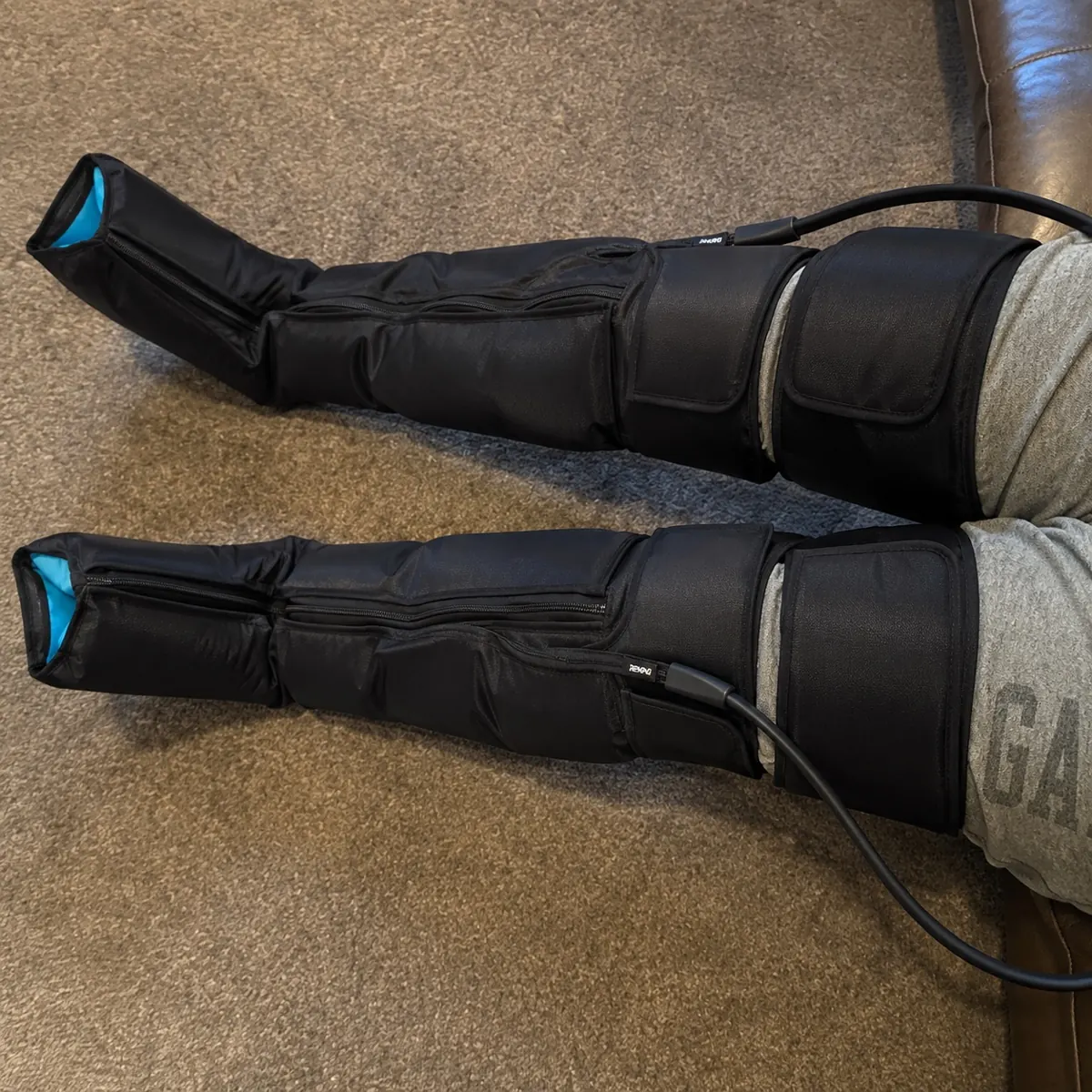
Compression boots are a comfort/recovery tool for me—not a replacement for medical care or rehab. If you want to compare the type of system discussed here, start with the product details, sizing, pressure settings and return policy.
My experience with compression boots
I bought into compression boots for a very ordinary reason: I wanted something that felt good after training. For me, they have delivered on that. After workouts, I like sitting down, putting the boots on and letting the chambers cycle through my legs. My legs feel less beat up subjectively, and the session gives me a forced period of recovery instead of immediately moving on to the next thing.
I also use them before bed. There is something relaxing about the rhythmic pressure, and I like the transition from an active day into a quieter evening. That does not mean the boots are improving my sleep physiology; it means the routine feels relaxing to me.
I have had my left knee replaced, and when the weather changes and my knees are bothering me, I sometimes find the boots soothing and feel that they relieve some of my discomfort. That is strictly my experience. I am not saying pneumatic compression treats an artificial knee, arthritis or weather-related joint pain, and I would not use my experience as a reason for someone with a painful or swollen knee to skip proper medical assessment.
How do compression boots work?
Recovery boots are a consumer version of intermittent pneumatic compression, often shortened to IPC. The sleeves contain multiple air chambers. A pump fills and releases those chambers in sequence, producing pressure that moves up the leg. Medical IPC has long been used in specific clinical settings, but a sports-recovery session at home is not the same thing as physician-directed compression therapy.
That difference gets blurred in marketing. A device can use the same broad mechanism while having a completely different purpose, pressure, protocol and evidence base. When we talk about compression boots for workouts, the relevant question is whether they improve recovery in healthy active people—not whether IPC has medical uses elsewhere.
The sensation is somewhere between a firm squeeze and a mechanical massage. Pressure, chamber design and programs vary by device. More pressure is not automatically better. The goal should be comfortable compression, not proving how much squeezing you can tolerate.
Do compression boots actually improve workout recovery?
The evidence is much less dramatic than the advertising. A 2024 systematic review and meta-analysis of 17 studies involving 319 participants found trivial-to-small effects on muscular function, trivial-to-moderate effects on pain and soreness, and highly variable effects on muscle-damage markers. The authors concluded that IPC may have potential mainly for reducing perceived soreness, while stronger claims about physical recovery remain uncertain.
You can read the systematic review and meta-analysis on PubMed. A separate 2025 comprehensive review found only six eligible studies and concluded there was not enough evidence to establish compression boots as superior or inferior to other recovery methods. That review is also available through PubMed.
This is one of those areas where subjective usefulness and laboratory outcomes do not perfectly line up. If I tell you my legs feel better after a session, that is a legitimate description of my experience. It is not proof that muscle damage disappeared faster, inflammation was “flushed out,” or my next workout will be objectively stronger.
That distinction actually makes me more comfortable recommending the category carefully. You do not need a recovery gadget to alter blood biomarkers for it to have value. If twenty minutes in the boots feels good and encourages you to sit down and recover, that may be enough—provided the price makes sense to you and you are not substituting it for sleep, sensible programming, nutrition or medical care.
What compression boots cannot replace
Compression boots cannot compensate for repeatedly training harder than you can recover from. They do not replace adequate sleep, enough calories, protein, hydration, rest days or intelligent programming. If your legs are constantly destroyed because every workout is a max-effort test, the answer is probably not a more expensive recovery gadget.
That is why I see the boots as an accessory. Our guide to why workout recovery takes longer after 40 covers the fundamentals, and protein for men over 40 deals with one of the basic nutritional pieces. If those foundations are missing, start there.
The same applies to soreness. Normal delayed-onset muscle soreness is one thing; sharp pain, major swelling, instability, redness, heat, or symptoms that keep getting worse are another. A compression session should not become a way to numb your judgment about an injury.
How I use compression boots after workouts and before bed
My approach is simple. After a workout, I get comfortable and use a moderate setting that feels firm without being painful. I am not trying to turn recovery into another endurance contest. Research protocols vary, but the 2024 meta-analysis noted that sessions around 20 to 30 minutes and pressures around 80 mmHg were commonly used in the studies it reviewed. That does not mean 80 mmHg is the correct setting for every person or every consumer device.
Before bed, the purpose is different. I am not chasing a performance metric. I use the boots because the rhythmic compression helps me slow down and my legs feel good afterward. If I am already comfortable and recovered, I do not feel compelled to use them just because I own them.
On days when my knees are bothering me, particularly around weather changes, I sometimes use the boots because I find the overall leg compression soothing. With a replaced knee, I am especially careful not to turn that personal observation into treatment advice. Anyone with a joint replacement should follow their own surgeon or healthcare team's guidance about compression devices and unexplained pain or swelling.
Compression boots vs stretching, walking and massage
You do not need to choose one recovery method forever. Light walking can feel great after hard training. Mobility work can be useful when it addresses a real limitation. Massage may be enjoyable. Compression boots have the advantage of being passive: you can read, watch something or simply relax while the device cycles.
That convenience is probably one reason people actually use them. A recovery strategy that feels pleasant and fits your life may get used more consistently than a theoretically perfect routine you avoid. But convenience should not be confused with superiority. The current evidence does not establish IPC as a universally better recovery method.
If your main goal is rebuilding general fitness rather than squeezing another one percent out of recovery, articles like Rucking for Beginners, Farmer's Walks After 40 and Getting Winded More Easily After 40 are likely more important than the boots themselves.
Who should be cautious with compression boots?
Because these devices apply pressure to the legs, they are not something I would casually recommend to everyone. If you have known or suspected blood clots, significant peripheral vascular disease, severe swelling of unknown cause, active skin infection or wounds, significant heart or circulation problems, or recent surgery, ask a qualified clinician whether pneumatic compression is appropriate for you.
Stop if the boots cause pain, numbness, tingling, skin color changes, unusual coldness or symptoms that feel wrong. Sudden one-sided leg swelling, warmth, redness or pain can be signs of a blood clot and deserves urgent medical attention rather than a recovery session.
People with joint replacements also have individual circumstances. My replaced left knee is part of my personal story, not a blanket recommendation for other knee-replacement patients. If you have a prosthetic joint and are unsure about compression, your surgical or rehab team is the right place to ask.
What I would look for when buying compression boots
Fit comes first. The sleeves need to accommodate your leg length and circumference without awkward bunching. Next, look at pressure adjustability. I would rather have several usable settings than one brutally aggressive mode. Controls should be simple enough that you will actually use them.
Then consider how the boots connect to the pump, how bulky the system is, whether the sleeves are easy to clean, and how much room they take up. If you plan to travel with them, portability matters more. If they will live beside your couch, it matters less.
Finally, look at warranty and return policy. Compression boots are much more expensive than a foam roller. You want enough time to determine whether you genuinely enjoy using them rather than convincing yourself they work because you spent money.
For me, compression boots have earned their place because I actually use them after workouts and before bed. I value the comfort and relaxation more than any promise of “accelerated recovery.”
Are compression boots worth it?
If you train regularly, enjoy compression and have the budget, I think they can be a satisfying recovery tool. My own experience is positive: they feel good after workouts, help me relax before bed, and I appreciate them on days when my knees feel cranky. That is enough for me to keep using them.
If you are buying them because an ad convinced you they will erase muscle damage, dramatically improve circulation in every healthy person, or replace proper recovery, I would lower expectations. The research is mixed and the strongest recent synthesis suggests the benefits are more convincing for perceived soreness than for objective recovery of muscular function.
Bottom line: compression boots can be useful because they feel good and may modestly help perceived soreness, but they are an optional recovery accessory. Sleep, training load, food, protein and time still do the heavy lifting.
For a simpler tool, see my tennis ball massage guide, including seated foot rolling and a demonstration video. It is a different kind of self-care, with a focus on light, controllable contact.
For the maintenance side of ownership, see how to clean compression boots without damaging them. It distinguishes sleeves, connections and powered parts and links to model-specific instructions.

Tim Lekach founded Vitamin Hippo and has written about health, supplements and men’s wellness since the site’s original run. He personally used GenF20 Plus and now separates first-hand experience from clinical evidence and manufacturer claims.
More about Tim and Vitamin Hippo →