
On this page
A PEMF mat uses coils to produce pulsed electromagnetic fields while you lie or sit on the device. Some premium mats combine PEMF with far-infrared heat, red/near-infrared light and mineral or gemstone layers. Clinical PEMF research is legitimate, particularly in selected musculoskeletal applications, but the evidence varies by condition and by device parameters. A consumer wellness mat should not be treated as interchangeable with a medical PEMF protocol. I enjoyed the BON CHARGE mat I tried enormously as a relaxation experience; that is my experience, not proof of a medical benefit.
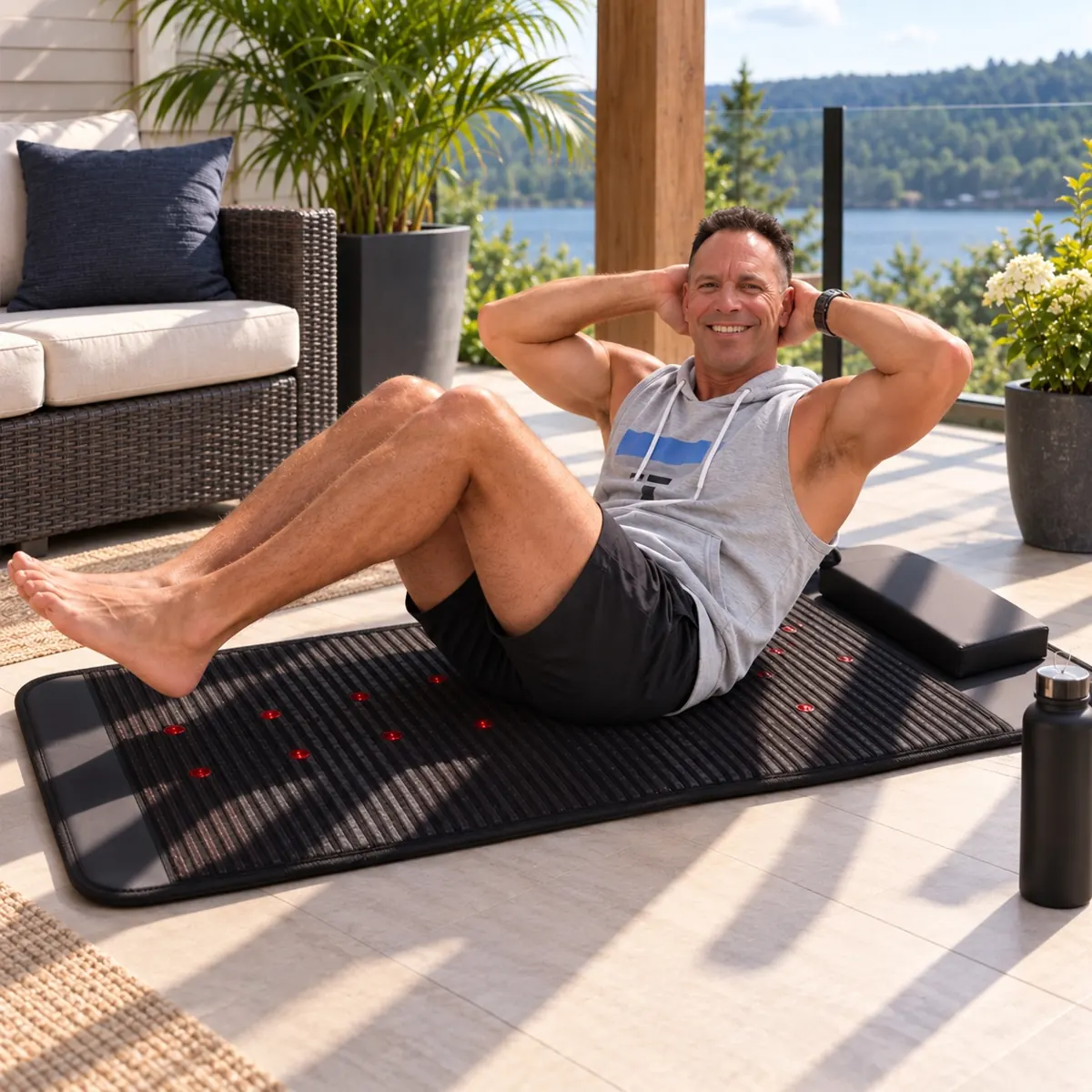
My first experience with a PEMF mat
I do not own the BON CHARGE mat, BON CHARGE did not send it to me, and I am not currently an affiliate for BON CHARGE or any PEMF manufacturer. I happened to have access to one while staying at an Airbnb and finally got the chance to try technology I had been curious about for a while. What follows is my experience—not a sponsored review and not a comparison test against other PEMF mats.
I have been intrigued by the principles behind pulsed electromagnetic field therapy for a while, but until this trip I had never spent meaningful time on a full-body PEMF mat. The Airbnb where I was staying had a BON CHARGE mat, so naturally I tried it.
My first reaction was not dramatic or medical. It was simply: this is a wonderful way to lie down and switch gears. I used it flat, let myself settle into it and found the whole experience deeply relaxing. I was arriving in vacation mode physically, but my brain had not necessarily caught up yet. Spending time on the mat felt like a deliberate transition out of normal life and into the trip.
I also loved the physical construction. The semi-precious gemstone and crystal layer gave it a substantial feel that was very different from lying on an ordinary exercise mat. BON CHARGE says its current Mat Max combines PEMF with far-infrared heat, 660 nm red light and 850 nm near-infrared light, with PEMF settings from 1 to 30 Hz. Those are separate modalities layered into one product; the presence of crystals should not be confused with evidence that gemstones themselves create the clinical effects studied in PEMF research.
I thought it was wonderful technology and I would happily use one again. Lying flat on it was deeply relaxing and helped me shift into vacation mode, and I especially enjoyed the semi-precious gemstone and crystal layer as part of the physical experience. But I have only personally tried this one PEMF mat. I cannot tell you from hands-on testing that BON CHARGE is better than Hooga, HigherDOSE or another manufacturer. My recommendation is simply that, if you are curious and can try a quality mat before spending four figures, I think the experience is worth exploring.
The mat I tried was from BON CHARGE. Their current full-size Infrared PEMF Mat Max combines PEMF, infrared heat and red/near-infrared light. I do not own it and this is not a paid endorsement.
What is PEMF—and what is a PEMF mat actually doing?
PEMF stands for pulsed electromagnetic field. Instead of producing a continuous magnetic field, a PEMF device sends electromagnetic pulses according to defined parameters. A mat places coils across a larger surface so the user can receive exposure while lying down. Smaller PEMF devices may focus on one joint, limb or treatment area.
The key word is parameters. Frequency, intensity, waveform, pulse duration, treatment time and coil placement can all differ. That is one reason it is too simplistic to say “PEMF works” or “PEMF does not work” as though every device and every protocol were identical. A clinical study using a specific device at a specific dose for knee osteoarthritis does not automatically validate every consumer mat running every preset.
Cleveland Clinic describes PEMF as a complementary therapy that sends low-level electromagnetic pulses into the body and notes that experts are still studying its potential benefits. That is a useful middle ground: this is not imaginary technology, but neither is it a universal cure. See the Cleveland Clinic overview of PEMF therapy.
Why are frequencies such a big part of PEMF marketing?
Frequency is measured in hertz (Hz), meaning cycles per second. Consumer mats often offer multiple low-frequency presets, sometimes with names suggesting relaxation, sleep, recovery or focus. The BON CHARGE Mat Max currently lists a 1–30 Hz PEMF range; Hooga lists 1–50 Hz on its standard infrared PEMF mat and a broader preset range on its red-light model.
The science does suggest that treatment parameters matter. A 2026 meta-analysis of randomized trials in knee osteoarthritis found that outcomes varied with timing and PEMF parameters, while also warning about high risk of bias, heterogeneous protocols and uncertainty about clinical meaningfulness. That is exactly why I would resist internet charts claiming that one magic frequency reliably creates one specific mental or physical state.
Do PEMF mats really work? What the science actually says
There is real peer-reviewed research on PEMF, but the strongest responsible answer is “for what, using which protocol?” Evidence is much more developed for certain musculoskeletal conditions than for broad wellness claims such as “detox,” anti-aging or instant whole-body optimization.
A 2024 systematic review covering 17 studies and 1,197 people with osteoarthritis reported promising results, particularly for knee osteoarthritis, while emphasizing substantial variation in devices and treatment duration. A separate review of reviews found that much of the underlying evidence was low or medium quality. More recently, a 2026 meta-analysis of nine randomized trials involving 457 people with knee osteoarthritis found a nuanced picture: some time-dependent improvements in pain, stiffness and daily activity, but no improvement in some overall or objective outcomes, high risk of bias and major protocol heterogeneity.
That mixed picture matters. It is more credible than either extreme. PEMF is not pseudoscience simply because wellness companies sell expensive mats, and an expensive mat is not clinically proven for every advertised purpose simply because some PEMF trials are positive.
Research in other musculoskeletal areas is also developing. A 2025 systematic review of nonspecific low-back pain found potentially beneficial effects on pain, but again highlighted heterogeneous settings. A 2025 meta-analysis of shoulder impingement trials reported improvements in short-term pain and function, while noting the small evidence base and variability in protocols. You can explore the 2024 osteoarthritis systematic review on PubMed and the 2026 knee osteoarthritis meta-analysis.
What about workout recovery?
This is where wellness language can get ahead of direct evidence. It is reasonable for an active person to be interested in PEMF as part of a recovery routine, but “recovery” covers soreness, perceived fatigue, inflammation, sleep, performance restoration and actual tissue healing. Those are not interchangeable outcomes.
For me, the most defensible use of a home mat right now is as a recovery ritual: a reason to stop, lie down, relax and potentially combine PEMF with heat or light if the device includes those features. That pairs naturally with the other recovery tools I use and write about, including compression boots, workout recovery after 40 and sleep and circadian habits.
PEMF is not the same thing as red light or infrared heat
This is one of the easiest things to misunderstand when shopping because premium mats often bundle several technologies together. PEMF uses electromagnetic pulses generated by coils. Red and near-infrared light therapy uses specific wavelengths of light. Far-infrared heating elements produce heat. They can coexist in one mat, but they are not the same intervention and they do not share one evidence base.
That distinction also makes product comparisons more useful. If you mainly want heat, you may not need an expensive PEMF system. If you already own a red-light panel, paying extra for LEDs inside a mat may matter less. If PEMF itself is what fascinates you—as it does me—look closely at the PEMF specifications instead of buying based on how many wellness buzzwords appear on the product page.
PEMF mat vs infrared mat vs red-light therapy
The easiest way to think about these products is that PEMF is the electromagnetic-pulse component, infrared is the heat component, and red/near-infrared light is a photobiomodulation component. A premium wellness mat can combine two or all three, but stacking more modalities does not automatically prove better clinical results.
| Feature | PEMF mat | Infrared mat | Red-light mat or panel |
|---|---|---|---|
| Primary technology | Pulsed electromagnetic fields | Infrared-generated heat | Red and/or near-infrared light |
| What reaches the body | A changing electromagnetic field | Thermal/infrared energy | Specific wavelengths of light |
| What you usually notice | Often little from PEMF itself | Warmth | Visible red light; sometimes warmth |
| Typical consumer use | Recovery, relaxation and wellness | Heat, relaxation and muscle comfort | Photobiomodulation, skin and recovery applications |
| Needs direct skin exposure? | No | No | Light needs an unobstructed path to the target area |
| Produces heat? | Not inherently | Yes | Some devices feel warm, but heat is not the core mechanism |
| Can it be combined? | Yes | Yes | Yes |
| Same as PEMF? | — | No | No |
Reading the table: these are different technologies. Combination mats can include two or three of them in one product; that does not make the evidence for one modality transferable to the others.
PEMF mat vs infrared mat: which makes more sense?
If what you mainly want is a warm surface that helps you unwind, an infrared mat may satisfy that goal without paying for PEMF electronics. If PEMF itself is the reason you are shopping, I would focus on the manufacturer's disclosed frequency range, field/intensity information where available, coil/core arrangement, session controls and safety guidance rather than treating heat as proof of a better PEMF device.
Combination mats make sense for someone who genuinely values the convenience of multiple modalities in one place. The BON CHARGE Mat Max I tried is a good example: the manufacturer lists PEMF at 1–30 Hz, far-infrared heat, 660 nm red light and 850 nm near-infrared light. Hooga's standard $899 mat combines PEMF with far-infrared heat, while its $1,199 model adds red and near-infrared LEDs. Those are meaningful feature differences, but they should not be interpreted as head-to-head clinical evidence that one mat produces better health outcomes than another.
PEMF mat vs compression boots
These are even more different. Compression boots use sequential pneumatic pressure around the legs; a PEMF mat generates pulsed electromagnetic fields while you rest on it. I use compression boots after workouts and sometimes before bed because I enjoy the mechanical compression and recovery ritual. The PEMF mat experience was more of a full-body lie-down-and-decompress ritual for me. Neither experience should be confused with proof that the device is treating an injury or medical condition.
PEMF mats are only one type of PEMF device
The full-body mat is the most visually obvious consumer format, but PEMF equipment comes in several forms. There are compact pads for sitting or localized use, wraps designed around a limb or joint, belts, chair mats, full-body mats and clinical systems used under professional supervision. Some consumer products are PEMF-only; others combine PEMF with infrared heat or red/near-infrared light.
Full-body mats make sense for someone who values the ritual: lie down, choose a program and stay there for a session. A wrap or smaller pad may make more sense if storage, portability, cost or a localized area is the priority. The best format depends on what you actually expect to do with it—not which device looks most impressive online.
How much does a PEMF mat cost in 2026/2027?
This is not a cheap wellness category. As of September 2026, the full-size products I checked span roughly $899 to $1,299 USD before moving into even more expensive specialty systems. Prices and promotions change, so treat these as a snapshot rather than permanent prices.
Hooga currently lists its full-body PEMF Mat with Infrared Heat at $899 USD. It lists six PEMF cores, 1–50 Hz presets, adjustable far-infrared heat and amethyst/tourmaline material. Its Red Light PEMF Mat is $1,199 USD and adds red/near-infrared LEDs.
BON CHARGE's current U.S. Infrared PEMF Mat Max is $1,299 USD. The current model lists a 1–30 Hz PEMF range, far-infrared heat, 660 nm red light, 850 nm near-infrared light, 24 LEDs and a semi-precious gemstone/crystal layer. The Canadian storefront lists it at $2,299.95 CAD at the time of writing.
That makes a PEMF mat a purchase I would research, not impulse-buy. If I were buying after my Airbnb experience, I would compare the actual PEMF controls, return period, warranty, dimensions, heat range, weight, electrical requirements and whether I genuinely wanted the bundled light/heat features.
A practical 2027 PEMF mat comparison
I have only personally used the BON CHARGE mat, so this is not a hands-on ranking. It is a research-based snapshot of published manufacturer specifications and prices checked in September 2026. Prices, warranties and specifications can change.
| Example | Listed price (USD) | PEMF | Heat / light | What stands out |
|---|---|---|---|---|
| Hooga PEMF Mat with Infrared Heat | $899 | 1–50 Hz presets; manual 1–30 Hz; 6 cores | Far-infrared heat | Lower-priced full-body example; 60-day trial and 2-year warranty listed |
| Hooga Red Light PEMF Mat | $1,199 | 0.9–100 Hz; 14 presets; 6 cores | Far-infrared + 150 red/NIR LEDs | Three modalities with independently controlled light/heat/PEMF |
| BON CHARGE Infrared PEMF Mat Max | $1,299 | 1–30 Hz | Far-infrared + 660/850 nm red/NIR | The only one here I have personally tried; full-body 42-lb mat with gemstone/crystal layer |
My take: I would not declare a “best PEMF mat” from this table. I have not tested these products head-to-head. What the table does show is why the category needs careful comparison: a roughly $400 jump can buy different frequency controls, light systems, warranties, dimensions and construction—not necessarily proven superior outcomes.
What matters before spending $1,000+
| Compare | Why I would check it |
|---|---|
| PEMF frequency range | Shows what programs/frequencies the device can generate; frequency is not the same thing as field strength. |
| Field intensity / output disclosure | Helps make the PEMF specification more meaningful when the manufacturer publishes it. |
| Full-body vs targeted | A wrap, chair pad and 6-foot mat fit very different routines. |
| Infrared heat | Useful if warmth is part of what you want, but it is a separate modality from PEMF. |
| Red / near-infrared light | Another separate technology; don't assume LEDs make the PEMF component stronger. |
| Preset programs | Can make the device easier to use, but more presets are not proof of better clinical efficacy. |
| Session limits | Manufacturer instructions vary. For example, BON CHARGE lists a 20-minute maximum for its PEMF setting. |
| Size and weight | Important if you need to store or move a full-body mat regularly. |
| Trial / returns / warranty | Especially important in a category where full-body products can cost four figures. |
There is legitimate clinical research on PEMF for specific applications, but that does not validate every wellness claim attached to every consumer mat, frequency preset or gemstone layer. Cleveland Clinic describes PEMF as a complementary, noninvasive therapy and recommends discussing at-home use with a healthcare professional. I think the responsible way to shop is to separate published evidence, manufacturer claims and your own subjective experience rather than blending the three.
What I would look for before buying a PEMF mat
1. Transparent specifications. I want to see frequency range, session limits, dimensions and what the product actually generates—not vague “quantum” language.
2. A realistic use case. If the mat weighs 40 pounds and you plan to hide it in a closet after every session, ask yourself how often you will really use it. BON CHARGE lists its full-size Mat Max at 42 pounds; Hooga lists its standard full-body mat at 24 pounds.
3. Separate the modalities. Decide whether you are paying for PEMF, heat, red light or the convenience of all three. More features are not automatically more effective.
4. Return policy and warranty. At roughly $900–$1,300 USD for the examples above, this matters. A product can be well built and still not fit your routine.
5. Safety guidance. Do not assume “low frequency” means appropriate for everyone. Cleveland Clinic recommends discussing PEMF with a healthcare provider before starting or purchasing an at-home device. Manufacturer manuals also contain device-specific contraindications and precautions. This is especially important if you have implanted electronic devices, are pregnant, have a significant medical condition or want to use PEMF for persistent pain rather than general relaxation.
Where a PEMF mat fits into my idea of healthy aging
I do not want Vitamin Hippo to become a catalogue of expensive gadgets. Most of the foundations of healthy aging are decidedly unglamorous: resistance training, enough protein, cardiovascular fitness, sleep, sensible body composition and consistency. You can read our guides to building muscle after 50, protein after 40, getting winded more easily after 40 and waking up at 3 a.m. before spending four figures on wellness technology.
But that does not mean gadgets have no place. If a tool makes recovery enjoyable enough that you actually stop and recover, that has practical value. That is what I liked about the PEMF mat. It gave me a place to lie flat, slow down and do nothing for a while. The electromagnetic-frequency side remains fascinating to me, but I do not need to exaggerate the science to say I loved using it.
PEMF mat FAQs
What does a PEMF mat do?
A PEMF mat uses embedded coils to generate pulsed electromagnetic fields over a larger body area. Consumer mats may also include heat, red/near-infrared light or mineral layers. The exact field parameters vary substantially between products.
Do PEMF devices really work?
There is legitimate clinical research showing potential benefits in some musculoskeletal conditions, but results vary by condition, protocol and outcome. That evidence should not be generalized into a claim that every consumer PEMF mat treats pain, improves sleep or speeds recovery.
How long do you lie on a PEMF mat?
Follow the specific device manual. Session length depends on the product and setting. BON CHARGE lists a maximum PEMF setting time of 20 minutes on its current Mat Max, while the overall timer can run longer for other modalities. Longer is not automatically better.
Is PEMF the same as red light therapy?
No. PEMF uses pulsed electromagnetic fields generated by coils. Red-light therapy uses light at specified wavelengths. Some premium mats combine both, which is why the terms can appear together on product pages.
Can you feel PEMF?
PEMF itself may not create an obvious sensation at the low intensities used by many consumer devices. If a mat also has infrared heat, that warmth is much easier to notice. My strongest subjective response was relaxation from the overall session rather than a dramatic sensation I could attribute specifically to the electromagnetic pulses.
Are the gemstones doing the PEMF?
No. The PEMF field comes from the device's electromagnetic coils. Gemstone layers are a separate physical/material feature. I personally liked the semi-precious gemstone/crystal layer in the BON CHARGE mat, but I would not use that preference as evidence of a medical effect.
Is a PEMF mat worth $1,000?
That depends on your budget and how often you will use it. After trying one, I can understand the appeal much more than I could from product photos. I loved the experience. But $1,000-plus is still substantial money, and I would prioritize exercise, sleep, nutrition and appropriate healthcare before buying a premium recovery mat.
Can PEMF replace physical therapy or medical care?
No. PEMF may be used as a complementary modality in some contexts. Persistent or unexplained pain, weakness, swelling, neurologic symptoms or injuries deserve appropriate assessment rather than self-treatment with a wellness device.
My 2027 verdict
PEMF mats sit in an interesting place heading into 2027: the technology has a genuine clinical research history, consumer products are becoming more sophisticated, and the wellness market is bundling PEMF with heat, light and increasingly premium materials.
My own experience was uncomplicated: I thought the BON CHARGE mat was wonderful. Lying flat on it was relaxing, it helped me mentally ease into vacation mode, I loved the substantial gemstone/crystal layer, and finally getting to experience PEMF after being intrigued by the frequency principles for years was genuinely fun.
Would I tell you it “healed” me after an Airbnb session? Absolutely not. Would I happily use one as part of a recovery and relaxation routine? Yes. That is the distinction I want Vitamin Hippo to keep making as we explore more wellness technology: enjoy what is useful, follow the science where it exists, and do not turn an interesting tool into a miracle.

Tim Lekach founded Vitamin Hippo and has written about health, supplements and men’s wellness since the site’s original run. He personally used GenF20 Plus and now separates first-hand experience from clinical evidence and manufacturer claims.
More about Tim and Vitamin Hippo →