
On this page
Creatine gummies in plain English
Creatine gummies are simply a more convenient delivery format for creatine. Instead of stirring powder into water, you chew enough gummies to reach the labeled serving. The important word is still creatine—not gummy. The evidence base belongs mainly to creatine monohydrate itself, especially when paired with resistance training.
That means a gummy should earn your money by making consistency easier, not by pretending the candy format turns creatine into a new compound.
My two cents: I prefer gummies over powder
If I am choosing between creatine powder and gummies, I prefer the gummies. That is a personal convenience preference from someone over 40, not medical advice and not evidence that gummies are more effective. I like the grab-and-go format and not having another scoop or shaker to deal with.
I am also sensitive to jittery workout products, which made me cautious about creatine initially. As we explain in our Creatine After 40 guide, pure creatine is not a stimulant. The thing I watch for is whether a product has caffeine or other stimulants added.
Creatine gummies: the format I prefer
I like the convenience of gummies over mixing powder. That is a personal preference—not evidence that gummies work better than creatine powder. The important things are the creatine dose, label quality and whether the product fits your routine.
Check on Amazon →Disclosure: As an Amazon Associate, Vitamin Hippo may earn from qualifying purchases at no extra cost to you.
Creatine gummies: my quick take
I made this short video to get straight to the point on creatine gummies and why I like the format.
What creatine itself is good for
Creatine helps replenish phosphocreatine used to rapidly regenerate ATP during short, intense efforts. Creatine monohydrate has decades of research behind it and is one of the better-supported sports supplements for improving high-intensity exercise capacity and supporting gains in lean mass during training.
After 40, that becomes interesting because maintaining strength and muscle matters more than chasing supplement novelty. Creatine does not replace resistance training, protein or recovery. It is an add-on to those fundamentals.
Do gummies work the same as powder?
If a gummy reliably delivers the labeled amount of creatine monohydrate, the delivery format should not magically change what creatine does in the body. The practical questions are dose accuracy, product quality, storage stability, sugar/calories, cost and whether the serving actually gives you the amount you think it does.
Gummies are more complicated to manufacture than dry powder because creatine can degrade in solution, particularly under acidic conditions over time. That does not prove that any specific gummy is underdosed, but it is a good reason to favor transparent labels, reputable manufacturing and third-party testing when available.
What I check on a creatine gummy label
First, I look for the form—creatine monohydrate keeps the evidence straightforward. Second, I look at grams of creatine per full serving, not per gummy. Third, I check how many gummies make a serving. Fourth, I look at added sugar and calories because a daily gummy habit can quietly add up.
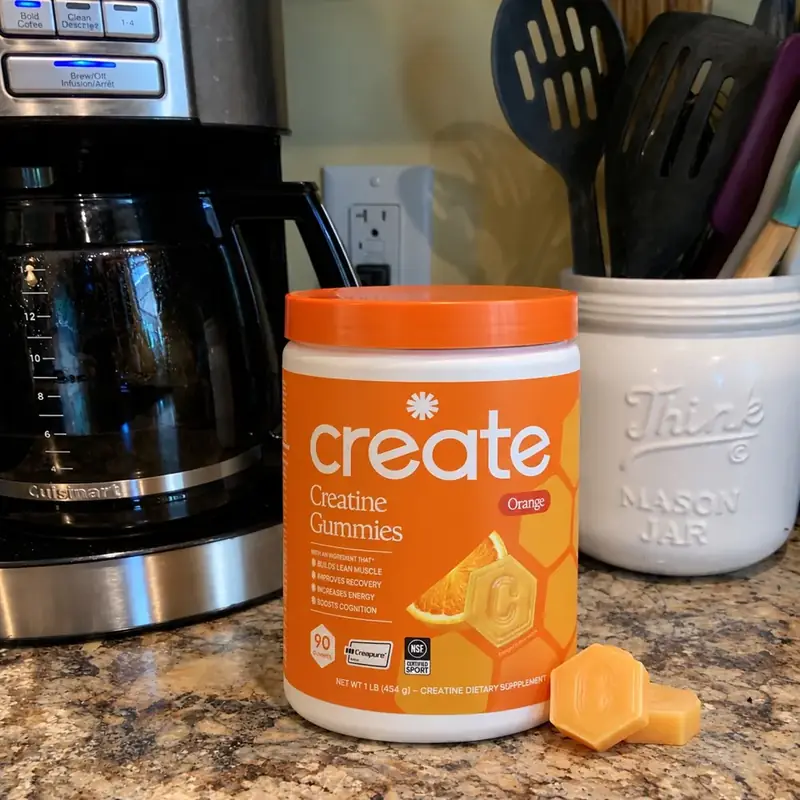
The Create gummies in my photo use Creapure-branded creatine and display an NSF Certified Sport mark on the package. Those are useful quality signals to investigate, but the package still deserves the same basic scrutiny as any supplement.
How much creatine are you actually getting?
A common maintenance amount used in research is roughly 3 to 5 grams of creatine monohydrate per day. Some protocols use loading phases, but loading is not required to eventually increase muscle creatine stores. With gummies, the only way to know where you land is to read the serving panel.
Do not assume that one gummy equals a full daily serving. If the product requires several gummies, calculate the total creatine and the total calories for that serving. Convenience is only convenient when the math still works for your goals.
The gummies I photographed
The orange Create Creatine Gummies shown here are the style I prefer over dealing with powder. If you want to inspect the current listing, serving size and price, you can see the creatine gummies on Amazon.
That is an affiliate link. My recommendation is about convenience and my personal preference for gummies, not a claim that this format produces better muscle or strength results than properly dosed creatine powder.
Who might prefer powder instead?
Powder still wins on simplicity and usually on cost per gram. If you already make a shake every day, adding plain creatine monohydrate is barely any extra work. Powder also avoids the extra ingredients needed to make a gummy taste and hold together.
So I would not tell someone who happily uses inexpensive powder to switch. Gummies solve a behavior problem: remembering and enjoying the routine. If they make you more consistent and the label checks out, that can be worth paying for.
A simple way to compare gummies before you buy
Start by ignoring the front of the tub. Turn it around and find the amount of creatine in a full serving. Then find the number of gummies in that serving. A product that says 'creatine gummies' in giant letters may still require several pieces to reach the amount used in common research protocols.
Next, compare the price per daily serving rather than the price per container. Powder usually has a major advantage here. Gummies require flavoring, manufacturing and packaging that a bag or tub of powder does not. I am willing to accept some convenience premium because I prefer gummies, but I still want to know what that convenience costs me over a month.
Then look at the extras. Added sugar may be modest, but it is still worth counting if you take the product every day. More importantly for me, I check for stimulants. Creatine itself is not caffeine, so there is no reason I need a gummy that sneaks an energy blend into the formula. If I want caffeine, I would rather make that decision separately.
Storage is another underrated issue. Gummies can be sensitive to heat and moisture. Follow the label, keep the lid closed and do not leave the tub baking in a hot car. Creatine is a stable dry powder, while formulations that introduce moisture and acidity create a more complicated stability problem. That is one reason reputable manufacturing and testing matter.
Finally, judge the product by whether it improves adherence. If you already take powder every day without thinking about it, gummies may solve a problem you do not have. If the powder tub sits untouched because you dislike mixing it, a well-formulated gummy can be a rational trade. My preference is the gummy, but convenience is the benefit I am buying—not superior physiology.
One more point matters after 40: do not let the supplement become more interesting than the training. Creatine can support a good program, but progressive resistance work is still the signal telling your body to adapt. I would rather see someone take no creatine and train consistently than buy the fanciest gummy and train sporadically. The best use of a supplement is to support habits that are already moving in the right direction, not to create the illusion that the basics have been handled.
Bottom line
Creatine gummies make sense when convenience is the reason you are inconsistent with powder. I personally prefer gummies. The evidence, however, is about creatine—especially creatine monohydrate—not about the candy format itself.
Read the dose, check the full ingredient list, avoid assuming creatine is a stimulant and compare cost per meaningful serving. Then put the real emphasis where it belongs: lifting consistently, eating enough protein and recovering well.
Sources & further reading

Tim Lekach founded Vitamin Hippo and has written about supplements, men’s health and healthy aging since the site’s original run. Vitamin Hippo separates personal experience, manufacturer claims and published evidence.
More about Tim and Vitamin Hippo →