
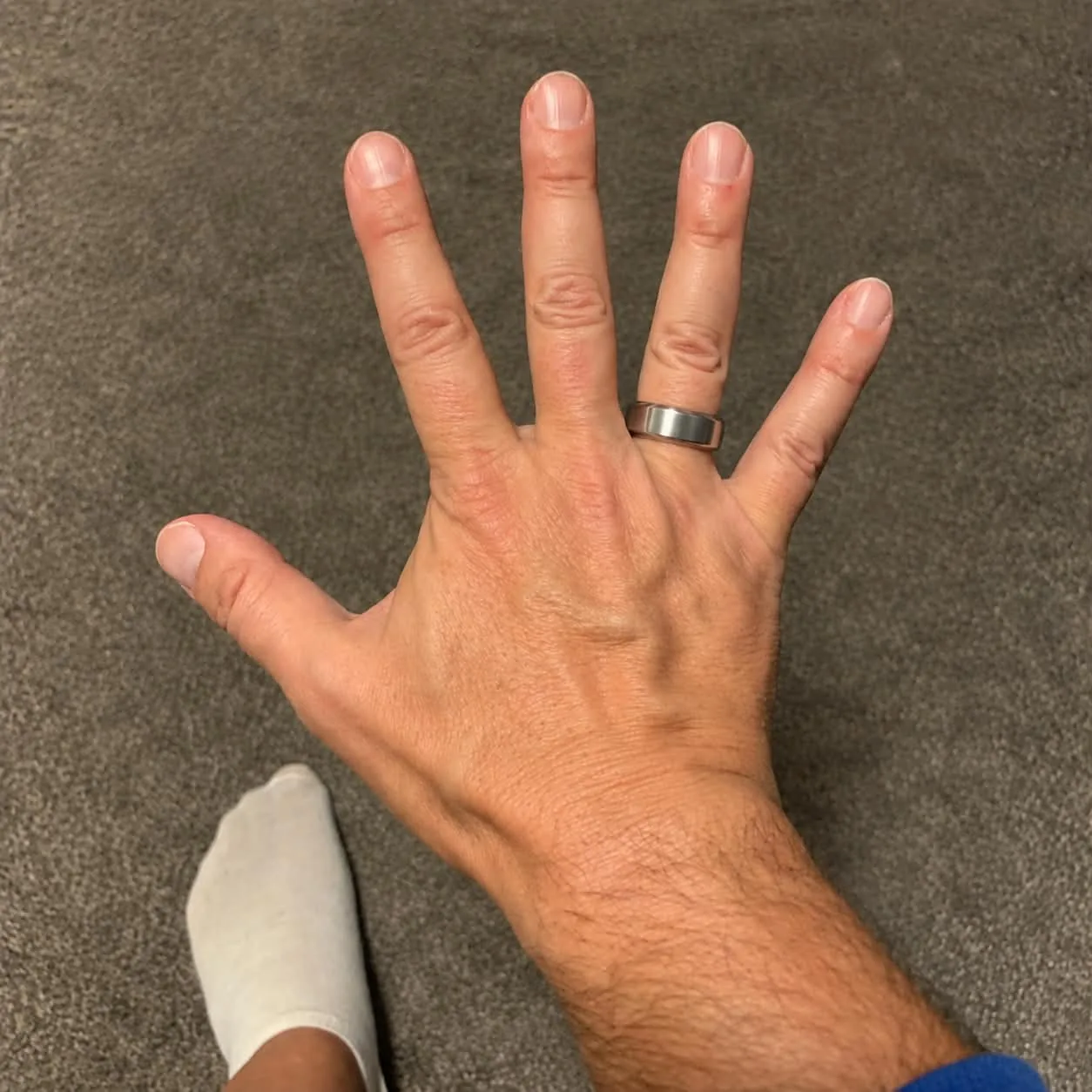
A smart ring has one major advantage for sleep tracking: you can forget you are wearing it. There is no bright watch face, no bulky wrist strap and, once the ring becomes part of your routine, very little friction between going to bed and collecting another night of data.
That does not make the data perfect. A ring does not read your brain waves the way a clinical polysomnography study does. Instead, it combines signals such as movement, pulse, heart-rate variability, temperature and breathing patterns, then uses algorithms to estimate what happened overnight.
I wear my brushed silver Oura Ring 5 every night, and it has become one of the tools I pay the most attention to when I am trying to understand how well I am actually sleeping and recovering. Mine is a size 9, and it is comfortable enough that wearing it overnight has simply become part of my routine.
Oura Ring 5
I use the brushed silver Oura Ring 5 nightly for sleep and recovery trends. If you want to see the current Amazon listing, sizes and pricing, you can use my affiliate link below.
View Oura Ring 5 on Amazon →Affiliate link. I may earn a commission from qualifying purchases.
What does a smart ring actually track while you sleep?
The exact feature set depends on the ring, but modern sleep-focused rings typically combine several sensors. Optical photoplethysmography (PPG) estimates pulse-related signals. An accelerometer detects movement. A temperature sensor follows skin-temperature trends. Some rings use red and infrared light for overnight blood-oxygen estimates.
The software then turns those raw signals into easier-to-read outputs: total sleep, estimated sleep stages, resting heart rate, heart-rate variability, respiratory rate, temperature deviation, sleep timing and composite sleep or recovery scores.
| Metric | What the ring senses or estimates | How I think about it |
|---|---|---|
| Total sleep | Estimated time asleep versus awake | Useful for trends and consistency |
| Sleep stages | Estimated awake, light, deep and REM periods | Interesting, but not a direct brain-wave measurement |
| Resting heart rate | Optical pulse signal overnight | Most useful compared with my own baseline |
| HRV | Variation in timing between heartbeats | A recovery trend, not a grade on my health |
| Respiratory rate | Estimated breathing pattern during sleep | I watch for unusual changes from baseline |
| Temperature trend | Nighttime skin-temperature deviation | Trend data, not the same as an oral thermometer |
| Blood oxygen | Overnight SpO2 estimate on supported rings | Useful context, not a diagnosis |
My experience with the Oura Ring 5
The number I tend to look at first is my sleep score. Rather than just telling me how many hours I was in bed, Oura breaks my sleep down into things like total sleep, deep sleep and REM sleep. I find those numbers useful because I can compare them with how rested I actually feel the following day.
It also tracks several overnight measurements, including heart rate, breathing rate, temperature trends and blood oxygen levels. I do not treat the ring as a medical device or try to diagnose anything from those readings. For me, the value is being able to watch my own trends over time.
The other reason I keep wearing it is the attention Oura gives to stress and recovery. Those are subjects I write about throughout Vitamin Hippo, so I am naturally interested in seeing how things like sleep, activity and everyday stress show up in my own data.
For me, that is really where the Oura Ring helps: it gives me a consistent set of measurements to pay attention to instead of relying entirely on how I think I slept or recovered.
Oura Ring 5 specs that matter for sleep
Oura launched Ring 5 in 2026. According to Oura, the fifth-generation ring is fully titanium, comes in sizes 6–13 and uses two tri-LED emitters, two photodetectors, a digital temperature sensor and an accelerometer. Oura lists six finishes, including the brushed silver finish I wear. The company describes Ring 5 as 40% lower in volume than Ring 4.
Oura's current battery guidance says a new Ring 5 typically lasts about 6–9 days per charge, with actual life depending on size, features and use. Battery longevity matters for sleep because a tracker that constantly needs charging is easy to leave on the charger overnight—the exact time you want it collecting data.
Oura Ring 5 hardware details →
| Oura Ring 5 detail | Published specification / feature |
|---|---|
| Material | Fully titanium design |
| Sizes | 6–13 |
| Finishes | Black, Silver, Stealth, Brushed Silver, Gold, Deep Rose |
| Optical system | Two tri-LED emitters and two photodetectors |
| Other sensors | Digital temperature sensor and accelerometer |
| Typical battery life | 6–9 days for a new ring, depending on configuration and use |
| My ring | Brushed Silver, size 9 |
How can a ring know whether you are in REM or deep sleep?
It does not “see” sleep stages directly. In a sleep lab, polysomnography uses signals including brain electrical activity, eye movements and muscle activity. A ring has a much smaller set of peripheral signals. Oura says its algorithm combines movement, skin temperature, resting heart rate, HRV and respiratory rate to classify awake, light, deep and REM periods.
That distinction is important because a beautiful sleep-stage graph can look more certain than the underlying measurement really is. Treat stages as estimates. They can still be useful—especially when patterns repeat—but a consumer wearable is not doing an EEG on your finger.
How accurate are smart rings for sleep?
Accuracy depends on the device, algorithm and metric. “Accurate” also needs a comparison standard. For sleep staging, the reference is usually polysomnography.
A 2024 validation study of Oura Generation 3 compared ring estimates with multi-night ambulatory polysomnography in 96 generally healthy adults across 421,045 thirty-second epochs. The researchers reported good agreement for several global sleep measures, with overall sleep/wake accuracy around 92% and stage-specific accuracy varying by stage. That study evaluated Gen 3 and its then-current algorithm—not Ring 5—so it should not be used as proof of exact Ring 5 performance. It does show why Oura has more validation evidence behind it than many anonymous marketplace rings.
Read the polysomnography validation study →
The metric I care about most: trends, not one-night perfection
If my sleep score drops once, I do not reorganize my life. One unusual night can reflect late food, alcohol, travel, temperature, stress, a hard workout, illness, a loose fit or plain measurement noise. What interests me is repetition.
If a metric that is normally stable shifts for several nights, that is more informative than obsessing over a single red number. Wearables become more useful when you compare yourself with yourself rather than treating an internet “optimal” HRV or deep-sleep number as a universal target.
Sleep score: useful shortcut or oversimplification?
Both. A composite score is useful because it compresses a messy night of data into something understandable. It is an oversimplification because two people can reach similar scores through different patterns, and the weighting is determined by the manufacturer's algorithm.
I use the score as an entry point. If it looks unusual, I open the details: total sleep, timing, awakenings, resting heart rate, HRV and stages. That prevents the score itself from becoming the goal.
Deep sleep and REM: don't chase the graph
Deep and REM sleep are fascinating because they make invisible physiology visible. They are also the easiest numbers to overinterpret. Oura's own documentation notes that the ring estimates stages from multiple biosignals. Even a good consumer algorithm will sometimes classify an epoch differently from a sleep lab.
If your ring says you had 54 minutes of deep sleep instead of 67, that precision should not tempt you into assuming your brain truly switched stages at exactly the timestamps shown. Look for broad patterns.
Heart rate and HRV overnight
Nighttime is a good environment for optical pulse sensing because you are relatively still. Oura uses heart-rate data in its sleep and readiness ecosystem. HRV—the variation in time between beats—is often discussed as a recovery signal. It can vary enormously between individuals, which is why your baseline is usually more meaningful than comparing your number with someone else's.
I find this especially useful alongside our broader recovery after 40 content. A ring does not tell me why I feel recovered, but it gives me another layer of context.
Temperature trends
Finger temperature is not the same thing as taking your temperature with a clinical thermometer. Wearables are typically looking for deviations from your own nighttime baseline. That can be useful for noticing change, but it should not be treated as a diagnosis or a replacement for appropriate medical measurement.
Blood oxygen and breathing data
Oura supports overnight blood-oxygen sensing and breathing-related information. This is another area where restraint matters. A consumer ring can provide useful trend information, but symptoms such as persistent breathing pauses, loud snoring with daytime sleepiness, chest symptoms or concerning oxygen readings deserve proper medical assessment rather than self-diagnosis from an app.
Oura itself frames its blood-oxygen feature as an overnight estimate. I treat it exactly that way.
Smart ring vs smartwatch for sleep
| Consideration | Smart ring | Smartwatch |
|---|---|---|
| Overnight comfort | Often unobtrusive once fitted correctly | Depends heavily on watch size and strap |
| Screen | Usually none | Useful by day, potentially distracting at night |
| Battery | Many models emphasize multi-day use | Varies widely; some need frequent charging |
| Workout display | Limited without phone | Strong for live pace, maps and workout metrics |
| Sleep focus | Core selling point for leading rings | Usually one part of a larger wearable platform |
| Fit issue | Finger sizing is critical | Straps are easier to adjust |
If live workout data is your priority, a watch is usually more capable. If you mainly want something discreet to collect nighttime data, the ring form factor makes a lot of sense.
What should you look for in a smart ring for sleep?
Comfort you can actually sleep in
A perfect sensor package is useless if you take the ring off at bedtime. Pay attention to thickness, weight, edges and whether your fingers swell overnight.
Proper sizing
A loose ring can compromise optical signals. A ring that is too tight becomes irritating. Use the manufacturer's sizing kit rather than assuming your jewelry size transfers exactly between generations or brands.
Battery life
Think in terms of charging behavior, not marketing maximums. Can you top it up while showering or sitting at your desk and still wear it every night?
Validation
Look for published comparison studies, preferably against accepted reference methods. A company saying “clinically accurate” on a product page is not the same thing as independent validation.
Subscription cost
The purchase price is not always the full cost. Some ecosystems require a membership for detailed insights. Include that in the multi-year cost before buying.
Data portability
If you already use Apple Health, Health Connect or another fitness platform, check what data can move in and out. A ring is more useful when it fits your existing system.
What smart rings cannot tell you
A ring cannot tell you with certainty why you woke up at 3 AM. It cannot diagnose insomnia, sleep apnea, an arrhythmia or a hormone problem from a consumer dashboard. It cannot replace how you feel. And it cannot make a poor sleep schedule healthy just because you have quantified it beautifully.
This matters because sleep tracking can become counterproductive when people start chasing perfect scores. If checking the app makes you anxious about sleep, less data may actually be more useful.
Can a smart ring improve your sleep?
The ring itself does not make you sleep. The potential value is feedback. If you notice that later bedtimes consistently line up with worse next-day experience, or that your sleep timing is more erratic than you realized, you have something concrete to experiment with.
That is why I connect this article to waking at 3 AM, morning sunlight and afternoon energy crashes. The ring is the measurement layer; habits are still the intervention layer.
What finger should you wear a smart ring on?
Follow the manufacturer's guidance because sensor placement and sizing differ. For Oura, fit matters enough that the company provides generation-specific sizing kits. My size 9 is comfortable for overnight use, which is more important to me than choosing a finger based on aesthetics.
Are cheaper smart rings worth considering?
Potentially, but compare more than the feature checklist. Two rings can both advertise heart rate, HRV, SpO2 and sleep stages while differing substantially in sensor quality, algorithms, app design, validation, data export and long-term software support.
If your goal is simply experimenting with the form factor, a cheaper ring may be enough. If you care about longitudinal sleep data, I would put validation and software quality ahead of a long list of unverified metrics.
My practical routine with Oura
- I wear it consistently overnight.
- I look at the sleep score first, then the underlying details when something looks different.
- I compare the data with how rested I actually feel.
- I pay more attention to multi-night trends than one strange night.
- I do not use the ring to diagnose myself.
That routine keeps the technology in its proper place: useful feedback rather than an authority over how I feel.
Oura Ring 5: what I like and what I would keep in mind
| What I like | What to keep in mind |
|---|---|
| Comfortable enough for me to wear nightly | Fit is personal; use the correct sizing kit |
| Sleep score gives me a quick starting point | A score simplifies complex physiology |
| Deep, REM and total sleep trends are easy to inspect | Stages are algorithmic estimates, not EEG measurements |
| Heart rate, breathing, temperature and oxygen add context | Consumer data should not be used to self-diagnose |
| Stress/recovery features match what I want to monitor | More data is only helpful if you use it calmly and consistently |
Who is a sleep smart ring best for?
I think the form factor makes the most sense for someone who wants passive overnight tracking, dislikes sleeping in a watch, enjoys looking at trends and is willing to wear the device consistently. It is less compelling if you know you will obsess over every number, dislike rings, or mainly want live workout metrics on your wrist.
Frequently asked questions
Are smart rings accurate for sleep?
The better devices can estimate total sleep and sleep/wake patterns reasonably well, but accuracy varies by metric and model. Sleep-stage estimates are not equivalent to polysomnography.
Can Oura detect sleep apnea?
Do not use a consumer ring to diagnose sleep apnea. Oura can provide breathing and blood-oxygen information, but suspected sleep apnea needs appropriate medical evaluation.
Do I need to wear it all day?
For sleep-only interest, nighttime wear provides the core sleep data, but broader readiness/activity features benefit from more continuous wear. Follow the device guidance.
Is the Oura Ring 5 comfortable?
Mine is. I wear a brushed silver size 9 nightly and it has become routine. Comfort is individual, which is why sizing matters.
How long does Oura Ring 5 battery last?
Oura currently lists typical battery life of roughly 6–9 days for a new Ring 5, with real-world results varying by ring size, features, settings and battery age.
Is a smart ring worth it just for sleep?
It can be if sleep trends are the main data you care about and you value the ring form factor. If you only want bedtime and wake time, your phone or a simpler tracker may already provide enough information.
Bottom line
Smart rings are useful because they make sleep tracking nearly frictionless, not because they turn your finger into a sleep lab. The strongest use case is longitudinal: wear the ring consistently, learn your baseline, notice changes, and compare the numbers with how you actually feel.
That is how I use my Oura Ring 5. I like having a consistent set of sleep and recovery measurements, and the ring is comfortable enough that I actually collect the data every night. I do not treat those measurements as diagnoses, and I do not let one score decide whether I had a “good” day.
See the Oura Ring 5 I use
I wear the brushed silver Oura Ring 5, size 9. Check the current Amazon listing for available finishes, sizing and price.
Check Oura Ring 5 on Amazon →Affiliate link. I may earn a commission from qualifying purchases.
Sources & further reading
- Oura Ring 5 hardware — Oura Member Care
- How Oura estimates sleep stages
- 2024 Oura Gen3 validation against polysomnography
- Oura battery guidance
See why my short warm shower before bed has become a 5–10 minute “splashdown” that helps me decompress and feel fresh before sleep.
Tracking is only one part of the picture. For a practical habit you can change without another device, try keeping your phone alarm while reducing bedtime scrolling.

Tim Lekach founded Vitamin Hippo in 2020. He writes about men's healthy aging using a mix of first-hand experience and published evidence. Product experiences are identified as personal observations rather than universal outcomes.
More about Tim and Vitamin Hippo →